Table of Contents
Introduction to EPFO SOP 2023 Compliance
The Employees' Provident Fund Organisation (EPFO) issued its Standard Operating Procedure (SOP) in October 2023, fundamentally reshaping the compliance landscape for all exempted PF trusts operating across India. EPFO SOP 2023 compliance is no longer optional — it is the baseline standard against which every exempted establishment will be measured during inspections, audits, and regulatory reviews. For PF trust managers, HR heads, and finance controllers, understanding the full scope of this document is the difference between a clean inspection report and a show-cause notice that can threaten the trust's exemption status.
Exempted PF trusts — establishments that manage their provident fund obligations independently rather than routing contributions through EPFO — have historically operated under a relatively light regulatory touch. That has changed decisively with the October 2023 SOP. The document formalises inspection frequencies, documentation standards, investment compliance requirements, and enforcement timelines into a single, binding operational framework. Every trust manager in India must read, understand, and operationalise its directives without delay.
What the EPFO SOP 2023 Covers
The SOP is structured around four core compliance pillars: interest rate crediting, investment norm adherence, documentation maintenance, and timely filing of returns. Each pillar has specific benchmarks and audit checkpoints that EPFO inspectors will verify during an on-site visit. EPFO SOP 2023 compliance requires that all four pillars be maintained simultaneously — a strong record on one does not excuse deficiencies on another. This integrated approach to oversight is one of the most significant shifts introduced by the October 2023 document.
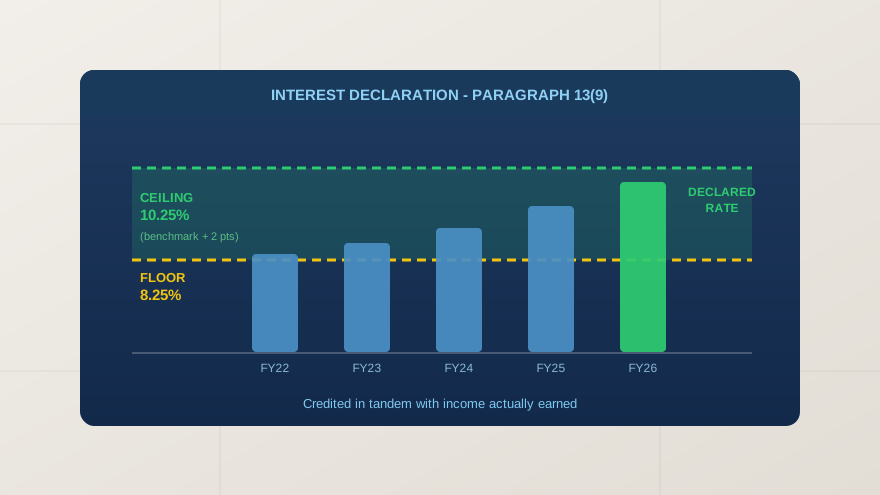
On interest rates, the SOP mandates that every exempted PF trust must credit its members at a rate equal to or higher than the EPF scheme interest rate announced by the Central Government each financial year. For FY 2024-25, that rate stands at 8.25%. Trusts that credited a lower rate — even marginally — will face mandatory show-cause proceedings under the new framework. The SOP removes any ambiguity that previously existed around grace periods or administrative delays in crediting, making timely and accurate interest declarations a non-negotiable obligation.
Investment compliance under the Pattern of Investment is equally tightened. The SOP requires that trusts submit a certified investment schedule to their EPFO regional office on a quarterly basis, confirming that at least 85% of the corpus is invested in approved government and government-backed instruments. This quarterly reporting requirement is new — previously, annual confirmation was considered sufficient for many regional offices. The shift to quarterly reporting demands real-time investment tracking and reporting capabilities that manual spreadsheets cannot reliably support.
Documentation Requirements Under the SOP
One of the most operationally demanding aspects of EPFO SOP 2023 compliance is the documentation framework it establishes. Every exempted PF trust must now maintain, in readily accessible form, the following records: Board of Trustee meeting minutes for the preceding three years, signed resolutions on investment decisions and interest rate declarations, annual audited accounts, member-wise contribution and withdrawal ledgers, and all formal correspondence with EPFO regional offices.
The SOP specifies that inspection officers will request these documents at the outset of any inspection. A trust that cannot produce complete documentation — even for periods before the SOP was issued — will have its gaps treated as compliance failures. This is particularly significant for older trusts that have historically maintained informal or inconsistent records. There is no provision for remedying documentation gaps retroactively once an inspection has commenced.
Trustee meeting records are a specific and frequently scrutinised area. The Board of Trustees must convene at least twice per financial year. Each meeting must have a formal agenda, signed attendance sheet, and minutes that record all decisions on investments, interest crediting, and any EPFO communications received during the period. Unsigned, undated, or reconstructed minutes that cannot be authenticated are treated as non-existent for inspection purposes — a finding that typically leads to a Category B violation.
Inspection Frequency and Enforcement Timelines
The October 2023 SOP sets a clear and structured inspection cycle: all exempted PF trusts are to be inspected at least once every three years. Trusts with outstanding violations, delayed filings, interest shortfalls, or a corpus exceeding ₹10 crore are subject to priority and accelerated scheduling. In practice, several EPFO regional offices are conducting annual inspections for high-risk trusts in the current compliance cycle — a frequency that demands a permanent state of inspection readiness rather than periodic preparation.
When a violation is found during an inspection, the SOP prescribes specific remediation timelines that are strictly enforced. Category A violations — the most serious, encompassing interest shortfalls and major investment breaches — must be fully addressed within 60 days of the show-cause notice. There is no extension mechanism under the SOP for Category A findings. Failure to remediate within this window triggers the formal process for cancellation of the trust's exemption status, which involves a hearing before the Regional Provident Fund Commissioner. For a detailed breakdown of all violation categories and their specific consequences, see our article on EPFO SOP 2023 violation categories A, B, and C.
Immediate Steps for Trust Managers
If you have not yet conducted a formal gap assessment against the October 2023 SOP, that is the first and most urgent step. Map your current practices against each of the four compliance pillars. Identify where your documentation is incomplete, where your investment ratio may be at risk, and whether your interest crediting is fully current for all open financial years. This structured assessment will identify where to focus your remediation effort before an inspection is scheduled or initiated.
Second, formalise your trustee meeting process immediately. If board meetings have been conducted informally or with inconsistent record-keeping, adopt a structured template for agendas, attendance, and resolutions. Maintain a centralised document repository — digital or physical — where all meeting records, EPFO correspondence, and compliance filings can be retrieved by date and category within minutes of an inspector's request.
Third, consider whether your current systems can support the quarterly investment reporting requirement. Manual spreadsheets are increasingly indefensible in an EPFO inspection context. Purpose-built PF trust management platforms that automate investment tracking, compliance ratio computation, and report generation are now effectively a necessity for sustained EPFO SOP 2023 compliance. MyPF Software is designed precisely for this — from real-time investment portfolio management to inspection-ready documentation generation. Request a demo to see how it can transform your compliance operations.
The Bigger Picture: Why EPFO Is Tightening Oversight
The October 2023 SOP did not emerge in a vacuum. EPFO has observed persistent non-compliance across a significant percentage of exempted trusts — interest shortfalls that disadvantage members relative to the statutory entitlement, investment violations that increase corpus risk, and documentation practices that make effective external oversight impossible. The SOP is EPFO's systemic response to these issues, and it signals a sustained institutional commitment to raising the compliance bar across all exempted establishments in India.
Trust managers who approach EPFO SOP 2023 compliance as a one-time exercise — addressing identified gaps and then reverting to previous practices — will find themselves unprepared for the next inspection cycle. The compliance environment in India is moving decisively toward continuous monitoring and real-time reporting. Organisations that embed compliance into their operational DNA — through sound governance structures, well-maintained documentation, and robust software — will navigate this environment successfully. Those that treat compliance as a reactive, inspection-driven activity will face escalating difficulty, cost, and risk.
For trust managers looking to build a sustainable, inspection-ready compliance framework, MyPF Software provides the tools, automation, and audit-trail capabilities needed to meet EPFO's evolving standards with confidence and efficiency.
Ready to simplify your PF trust compliance?
MyPF Software helps exempted PF trusts stay inspection-ready, automate filings, and manage investments — all in one platform built for India.